A five-second overview
We identify words whose frequencies are statistically associated with authorship, following the logic that GWAS uses to link genetic variants to traits.
In a nutshell
Can we look for features of writing style in the same way that geneticists look for DNA variants associated with height or disease? GWAS tests each genetic marker separately. We transfer that logic to language: word frequency becomes the marker, and authorship becomes the trait of interest.
We take texts with known authors, split them into comparable chunks, and count word frequencies. We then choose an author and ask the same question for every word: does the probability that a chunk belongs to this author vary with that word’s frequency?
The result is a map of lexical associations. Each word receives a coefficient, β, indicating the direction and strength of the association, and a p-value for testing the hypothesis of no association. Correcting for the thousands of words tested helps filter out chance findings. The map reveals both words characteristic of an author and words used comparatively rarely in that author’s texts.
Authorial frequency profile = DNA, Authorship = phenotype
A frequency profile records how often each word occurs in a text. In our analogy, this profile plays the role of DNA, while authorship is the phenotype. We want to find out which features of the profile are associated with a particular writer.
Take «чувствовать» (to feel). We measure its frequency in passages by Tolstoy and other authors, put the values on a common scale, and test for an association with authorship. Geneticists follow a similar procedure when testing a marker against a trait. We repeat this process for every word.
In our study, a higher frequency of «чувствовать» was associated with Tolstoy’s authorship. The association remained statistically significant after correction for multiple testing. Bringing these findings together gives us a detailed picture of a writer’s language, which we can explore further by returning to the texts.
See Sections 2–3 of the paper for the method and results. The work was presented at DH2026 and is available as a preprint.
The approach
Build comparable profiles
Lemmatize the texts and divide each work into non-overlapping chunks of 10,000 lemmas. The study analyses the 5,000 most frequent lemmas in each corpus and standardizes their frequencies.
Test one word at a time
Fit a separate logistic regression for each lemma: is its frequency associated with the chunk belonging to the author being studied rather than another author? The coefficient β indicates the direction and strength of that association.
Account for thousands of tests
Use the Bonferroni correction to make the significance threshold stricter. For example, with 5,000 tests and an overall level of 0.05, the threshold is 0.05 / 5,000 = 0.00001.
Check the pattern
Plot the word associations and compare the number of significant words with what arises after randomly shuffling authorship labels. In the paper, all three authors studied show more significant features than expected under random labelling.
Reading the figure
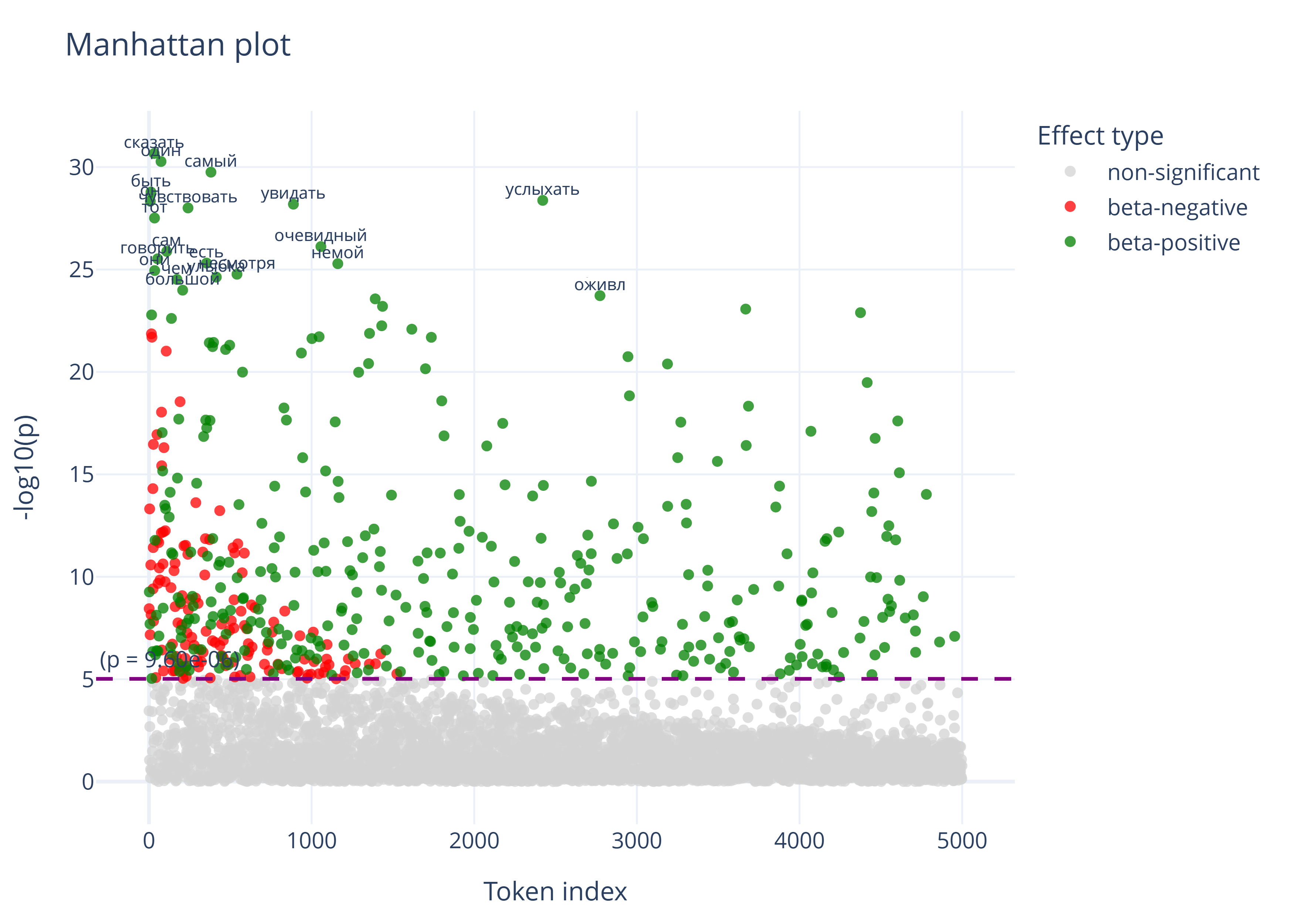
This Manhattan plot shows the analysis of Leo Tolstoy against the other authors in the Russian corpus. Each point is a lemma. Its horizontal position is its index in the feature list; its height, −log₁₀(p), represents evidence against the hypothesis of no association. Higher points have smaller p-values.
Open full-size figure · Figure source

Green: a higher word frequency is associated with Tolstoy. Red: a higher frequency is associated with the other authors. Grey: the association does not reach the corrected significance threshold. Colour shows direction; height shows statistical evidence, not effect size.
For instance, «сказать» (to say), «чувствовать» (to feel), «увидать» (to see), and «услыхать» (to hear) appear among the positive signals. They provide concrete starting points for reading how speech and perception are represented in these texts.
The study also finds lexical signals for H. G. Wells and Hermann Hesse in the English and German corpora. These associations describe the selected corpus; separating authorship from genre or period through additional model variables is a proposed next step.
Try it on your texts
The repository includes the analysis notebook, lemmatization code, dependencies, figures, and the DH2026 presentation. Start by reproducing a supplied example and checking the outcome labels and preprocessing before substituting your own texts.
Code & notebooks ↗Citation
From Genes to Tokens: a GWAS-inspired Approach for Interpretable Stylometric Analysis. arXiv:2606.09543 · Digital Humanities 2026.
BibTeX
@misc{pronin2026genes,
  author = {Pronin, Dmitry and Kazartsev, Evgeny},
  title = {From Genes to Tokens: a GWAS-inspired Approach for Interpretable Stylometric Analysis},
  year = {2026},
  eprint = {2606.09543},
  archivePrefix = {arXiv},
  url = {https://arxiv.org/abs/2606.09543}
}